Fine-Tuning vs RAG vs Prompt Engineering: A Decision Framework for Production AI
When should you fine-tune a model, build a RAG pipeline, or rely on prompt engineering? A practical framework based on data freshness, cost, accuracy requirements, and operational complexity. No theory without trade-offs.
Every team building with LLMs hits the same question within the first month: the base model is not good enough for our use case, so what do we do about it?
The answer usually comes from whoever on the team read the most recent blog post. If someone just read about RAG, they build a RAG pipeline. If someone attended a fine-tuning workshop, they start curating training data. If the deadline is tomorrow, they write more elaborate prompts and hope for the best.
None of these are wrong on their own. All of them are wrong if chosen without understanding what problem they actually solve. Prompt engineering, RAG, and fine-tuning address different failure modes. Pick the wrong one and you spend weeks building infrastructure that does not fix the actual issue.
This post provides a decision framework. Not “which is best” but “which is appropriate given your constraints.” The answer depends on why the model is failing, how your data changes, what accuracy you need, and what operational complexity you can absorb.
The Three Failure Modes
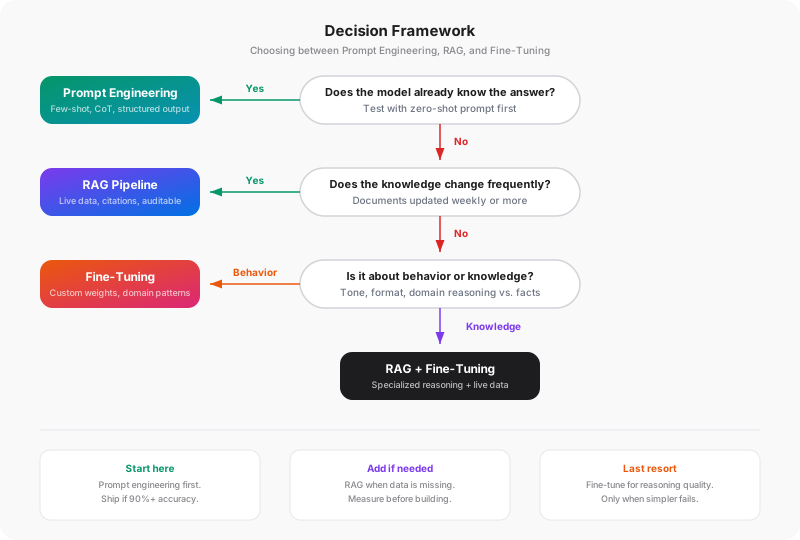
Before choosing an approach, identify why the model is underperforming. There are only three root causes:
The model knows the answer but expresses it poorly. It has the knowledge but the output format, tone, or reasoning structure does not match what you need. A customer support bot that gives correct but overly technical answers. A code generator that uses the wrong naming conventions for your codebase.
The model does not have the information. It cannot answer questions about your internal documentation, recent events after its training cutoff, or proprietary data it has never seen. No amount of prompt engineering will make it know your company’s leave policy or last quarter’s revenue numbers.
The model lacks the reasoning pattern. It cannot perform the type of analysis your domain requires. A general model asked to interpret radiology reports, apply specific legal precedent, or reason about circuit diagrams in the way a specialist would.
Each failure mode maps to a primary solution:
- Poor expression with correct knowledge: Prompt Engineering
- Missing information: RAG
- Missing reasoning patterns: Fine-Tuning
In practice, real problems combine two or three of these. But identifying the primary failure mode tells you where to start.
Prompt Engineering: The Underestimated Baseline
Prompt engineering is not the naive approach people dismiss when they want to build something more sophisticated. It handles a broad set of problems with zero infrastructure overhead, and in production that simplicity has compounding value.
What it solves: Format compliance, tone adjustment, reasoning structure, output consistency, classification accuracy, summarization quality. Anything where the model has the knowledge but needs guidance on how to apply it.
What it cannot solve: Questions about information the model has never seen. No prompt will teach the model your product catalog or internal API documentation.
Techniques that matter in production:
Few-shot examples are the most reliable technique for format compliance. Show the model three examples of correct output and it will match the pattern with high reliability. This eliminates entire categories of output parsing failures.
Chain-of-thought prompting forces the model to show its reasoning before giving a final answer, catching logical errors mid-stream. Wei et al. (2022) showed gains of +10 to +50 percentage points on arithmetic reasoning benchmarks (GSM8K, MultiArith). The pattern is consistent: on simpler tasks, the gain is modest. On multi-step math, it is dramatic.
System prompts define behavioral constraints. “Never mention competitor products.” “Always include a confidence score.” “If uncertain, say so explicitly rather than guessing.” These constraints hold up well in production when stated clearly and tested against edge cases.
Structured output schemas (JSON mode, tool-calling schemas) eliminate format variability entirely. The model produces valid JSON matching your schema every time. No parsing failures, no regex extraction, no hoping the model remembers your format instructions.
When to stop here: If few-shot examples and a well-structured system prompt achieve above 90% accuracy on your evaluation set, you do not need RAG or fine-tuning. Ship it. The operational simplicity is worth the remaining gap in most cases.
When to move on: If the model confidently produces wrong answers because it does not have access to the required information. Or if you need accuracy above 95% on domain-specific tasks and prompt engineering plateaus below that threshold.
RAG: When the Model Needs External Knowledge
Retrieval-Augmented Generation solves one specific problem: the model does not have the information it needs to answer correctly. You retrieve relevant documents and include them in the prompt so the model can ground its answer in actual source material.
I wrote a detailed implementation guide covering the full architecture: hybrid search, re-ranking, and evaluation. Here I will focus on when RAG is the right choice and when it is not.
What it solves: Questions about proprietary data, recently updated information, large document corpora that exceed context window limits, any scenario where answers must cite specific sources.
What it cannot solve: Reasoning quality. If the model cannot interpret the retrieved passages correctly, better retrieval will not help. RAG gives the model access to information. It does not make the model smarter about how to use that information. Ovadia et al. (2023) showed that RAG consistently outperforms fine-tuning for injecting knowledge into LLMs, but this advantage only holds when the retrieval step returns the right passages.
The real trade-offs:
Retrieval quality is the ceiling. Your RAG system is only as good as its retrieval. If the retriever pulls irrelevant passages, the model will either hallucinate or give a wrong answer grounded in the wrong source. Most RAG failures are retrieval failures, not generation failures.
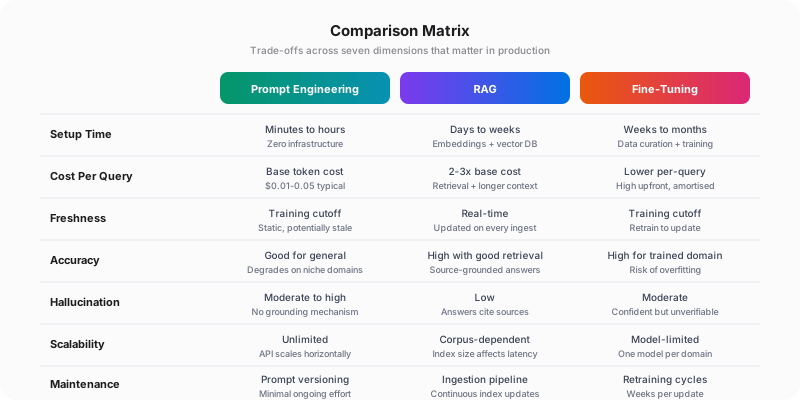
Latency increases noticeably. A RAG query involves embedding the question (5-20ms), searching the vector index (50-100ms for most managed services), optionally re-ranking results (100-300ms with a cross-encoder), then generating the answer with a larger context window. The generation step itself takes longer because you are sending 3-5x more input tokens. In practice, this adds 500ms-2s of overhead compared to a direct prompt, depending on how many retrieval and re-ranking stages you include.
Cost per query scales with context size. A direct prompt might send 1,000 input tokens and receive 500 output tokens. A RAG query sends the same question plus 3,000-5,000 tokens of retrieved context. That is 3-5x more input tokens, and you pay per token. Add embedding costs and vector database hosting, and total cost runs 2-4x higher than a direct prompt at typical context sizes. The exact multiplier depends on your model tier and how much context you retrieve, but the direction is always the same: more retrieval means higher cost per query.
Ingestion pipeline is ongoing infrastructure. Documents change. New ones arrive. Old ones get updated. You need a pipeline that re-embeds, re-indexes, and handles versioning. This is not a one-time setup cost. It is permanent operational overhead.
When RAG is clearly right:
- Internal knowledge bases where documents update weekly or more frequently
- Customer support systems that need to reference current product documentation
- Compliance and legal applications where answers must cite specific policy sections
- Any application where “I don’t know” is an acceptable answer and you need the system to recognize when it lacks relevant sources
When RAG is wrong:
- The model understands the domain but produces inconsistent output format (use prompt engineering)
- You need the model to reason differently, not just access different data (use fine-tuning)
- Your corpus is small enough to fit in a single prompt context window (just include it directly)
- Latency requirements are under 500ms (RAG adds too much overhead)
Fine-Tuning: When the Model Needs to Think Differently
Fine-tuning modifies the model’s weights to change how it reasons, not what information it has access to. This is the most misunderstood of the three approaches because people often fine-tune when they actually need RAG, or vice versa.
Soudani et al. (2024) tested this directly across 12 language models of varying sizes and found that RAG surpasses fine-tuning by a large margin for factual knowledge, especially for less frequently occurring information. Fine-tuning is not a knowledge injection mechanism. It is a behavior modification mechanism.
What it solves: Domain-specific reasoning patterns, consistent output style across thousands of variations, tasks where the model needs to behave like a specialist rather than a generalist.
What it cannot solve: Access to current information. A fine-tuned model still has a knowledge cutoff. If your data changes, the fine-tuned model does not know about the changes until you retrain.
When fine-tuning is justified:
Consistent domain-specific output at scale. A legal firm needs every contract review to follow the same analytical framework. A medical system needs radiology report interpretations that match how a specialist would reason. A code generation tool needs to produce code that follows your specific architectural patterns. These are reasoning patterns, not information retrieval problems.
Latency requirements below what RAG can deliver. A fine-tuned model responds at base model speed. No retrieval overhead. If you need sub-second responses with domain-specific quality, fine-tuning is the only path.
Cost optimization at very high volume. Every major provider has a clear tier structure: flagship models cost 5-20x more per token than their smaller counterparts. If you can fine-tune a smaller, cheaper model to match the quality of a larger model on your specific task, the per-query savings are 80-94% depending on the model pair. Microsoft’s Orca 2 research (2023) demonstrated 13B-parameter models performing “similar to or better than models 5-10x larger” on reasoning tasks after targeted fine-tuning. At 500,000+ queries per day, the training cost amortizes within weeks.
The costs that matter:
Training data curation is the real expense. You need hundreds to thousands of high-quality input-output pairs. Creating these costs expert time, which is expensive. Bad training data produces a confidently wrong model, which is worse than no fine-tuning at all.
Retraining cycles are slow. Each model update requires new training data, a training run (hours to days), evaluation, and deployment. If your requirements shift monthly, you are retraining monthly. That is expensive and operationally heavy.
Model drift is invisible without monitoring. A fine-tuned model can degrade as the world changes around it. The legal precedents shift. The medical guidelines update. The model still produces answers based on its training data, confidently and incorrectly. You need ongoing evaluation to catch this.
Vendor lock-in deepens. Fine-tuned models are not portable between providers. You cannot take an OpenAI fine-tune and run it on Anthropic’s infrastructure. Switching providers means retraining from scratch.
The Hybrid Approaches That Actually Work
Production systems rarely use a single technique in isolation. The effective patterns combine approaches strategically.
Prompt Engineering + RAG is the most common pattern in production. The Menlo Ventures 2024 enterprise AI survey of 600 IT decision-makers found that RAG accounts for 51% of production GenAI deployments, with prompt engineering (without RAG) covering most of the remainder. Fine-tuning sits at just 9%. RAG retrieves the relevant context. Prompt engineering ensures the model uses that context correctly: citing sources, maintaining output format, applying the right reasoning framework to the retrieved information.
RAG + Fine-Tuning works for specialized domains where you need both current knowledge and expert reasoning. Balaguer et al. (2024) tested this combination on an agricultural knowledge task and found that fine-tuning alone gave +6 percentage points over the base model, RAG added +5 more, and the combination performed best overall. Fine-tune the model to reason like a domain expert. Use RAG to provide it with current information. The fine-tuning handles the how-to-think. The RAG handles the what-to-know.
Prompt Engineering + Fine-Tuning works for high-volume consistency. Fine-tune for the core task, then use system prompts for per-customer or per-request customization. A content generation system fine-tuned on your brand voice, with prompts that adjust tone for different audience segments.
All three is rare but legitimate. A customer support system with a fine-tuned model (for your specific communication style), RAG (for current product documentation), and prompt engineering (for per-conversation context and rules). Only justified at significant scale where each layer measurably improves a different quality dimension.
The Decision Framework
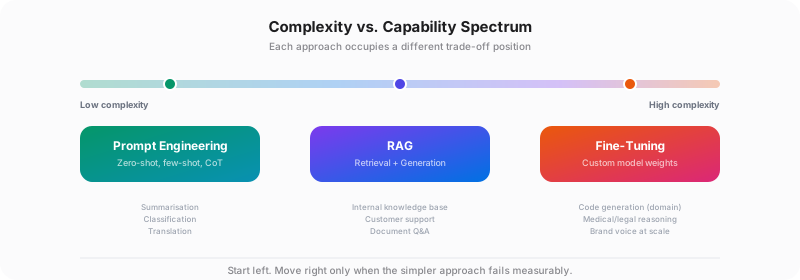
Start with the simplest approach and add complexity only when measurement proves you need it. OpenAI’s own model optimization guide recommends this exact hierarchy: start with evaluation, then prompt engineering, then fine-tuning only when prompting is insufficient.
Step 1: Establish a baseline with prompt engineering. Write a well-structured prompt with few-shot examples. Measure accuracy on a representative evaluation set of 50-100 examples. If accuracy exceeds your threshold, stop. Ship this.
Step 2: If the model lacks information, add RAG. When the model gives wrong answers because it does not have access to the relevant data, build a retrieval pipeline. Measure whether retrieval quality (Recall@10) and end-to-end accuracy improve beyond the prompt-only baseline. If yes, this is your architecture.
Step 3: If the model lacks reasoning quality, consider fine-tuning. When retrieval provides the right information but the model still cannot reason about it correctly, or when you need consistent specialist-level output at scale, fine-tuning is justified. But only after you have proven that prompting and RAG cannot achieve the quality threshold.
Step 4: Measure before combining. Each additional layer adds operational complexity. Before adding fine-tuning on top of RAG, measure what specific quality gap it would close. If the answer is “maybe 3% accuracy improvement”, the operational cost of maintaining a fine-tuned model probably exceeds the value of that 3%.
What I See Teams Get Wrong
Fine-tuning for knowledge. The most common mistake. A team has internal documentation and fine-tunes a model on it. The model memorizes facts during training, but cannot be updated when documents change. Three months later, the model confidently cites outdated policies. RAG would have solved this without the staleness problem. Ovadia et al. (2023) confirmed what practitioners already know: unsupervised fine-tuning is a poor mechanism for teaching LLMs new factual knowledge.
RAG for style. A team wants consistent brand voice across generated content. They build a RAG pipeline that retrieves examples of good content. The model sees the examples but still produces generic output because the problem is behavioral, not informational. Prompt engineering with few-shot examples would have worked. Fine-tuning would work at scale.
Skipping prompt engineering entirely. A team jumps straight to RAG or fine-tuning because they assume the base model cannot handle their task. In many cases, a well-crafted prompt with 5-10 examples achieves 90%+ of the quality they need. The remaining 10% might not justify weeks of pipeline development.
Not measuring before adding complexity. Every layer you add is a layer you maintain. RAG adds an ingestion pipeline, embedding updates, index management, and retrieval quality monitoring. Fine-tuning adds training data management, retraining schedules, model versioning, and drift detection. Only add these costs if measured results justify them.
The One Rule
Start simple. Measure. Add complexity only when the measurement proves the simpler approach fails.
The best production AI systems are not the most sophisticated ones. They are the ones where every layer of complexity exists because someone measured the gap, proved the simpler approach could not close it, and accepted the operational cost of the additional layer deliberately.
Ship the simplest thing that meets your accuracy threshold. Then measure whether you actually need more.