Why Offline-First Architecture Matters for Retail Software
Most retail software assumes you have reliable internet. In the real world, that assumption costs stores money every day.
When we started building Store Pulse, we made a decision in the first week that shaped every architectural choice that followed: the application must work perfectly without an internet connection. Not degraded mode. Not limited functionality. Full, unrestricted operation regardless of connectivity.
This was not a technical preference or an ideological stance about cloud computing. It was a business requirement driven by spending time in actual retail stores and observing how they operate.
The Reality on the Ground
Medium-sized retail stores do not operate in controlled environments with enterprise-grade networking. They operate in shopping complexes where fifty businesses share a single ISP connection. In strip malls where the router is in a closet three shops down. In areas where the ISP delivers “up to 50 Mbps” but the reality is 3 Mbps on a good day and nothing during peak hours.
We visited over a dozen stores before writing our first line of code. The pattern was consistent: every store owner had a story about the day their POS system went down because of an internet outage. Some could quantify the lost revenue. One grocery store owner estimated he loses 20,000 SEK on a typical outage day because customers walk out rather than wait.
Power fluctuations are another reality. Many stores experience brief power interruptions that reset networking equipment. The internet comes back in five minutes, but if your POS system needs to re-authenticate with a cloud server, re-download session state, and re-establish connections to payment processors, those five minutes become fifteen. During a Saturday rush, fifteen minutes of downtime is devastating.
The Architecture: Local-First, Not Cloud-Optional
“Offline-capable” and “offline-first” sound similar but lead to fundamentally different architectures. An offline-capable application is designed for the cloud and has fallback behaviour when the connection drops. An offline-first application is designed for local operation and treats connectivity as an optional enhancement.
The difference shows up in every technical decision.
Data Storage
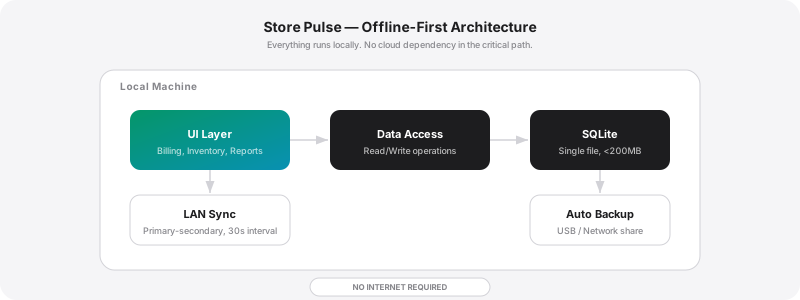
Store Pulse uses SQLite as its primary database. Every piece of data, inventory, customers, transactions, reporting, lives in a single database file on the local machine.
We chose SQLite deliberately over heavier alternatives. It requires zero configuration, no separate database server process, handles concurrent reads efficiently, and the entire database is a single file that is trivial to back up (copy the file) and restore. For a retail application processing hundreds of transactions per day on a single machine, SQLite’s performance ceiling is orders of magnitude above what we need.
The database schema is designed for the retail domain specifically. Inventory tables are structured for fast stock lookups and barcode resolution. Transaction tables are append-optimised for rapid billing. Reporting views are pre-aggregated for instant dashboard loading. The entire database for a typical store with 10,000 SKUs and a year of transaction history is under 200 MB.
Application Architecture
Store Pulse is a cross-platform desktop application (Windows and Mac) built with a local-first architecture. The UI layer talks directly to the local database through a data access layer. There are no API calls, no authentication servers, no cloud dependencies in the critical path.
Application startup is deterministic: open the database file, load the UI, ready to transact. On a modest machine, the kind of hardware you find behind a retail counter, this takes under three seconds. Compare this to cloud-based POS systems we tested, which took 15-45 seconds to start depending on connection quality, and sometimes failed to start at all when the internet was down.
Backup Strategy
With all data local, backup becomes the user’s responsibility, and we take that seriously. Store Pulse implements one-click manual backup from within the app. The backup is a copy of the SQLite database file, timestamped and stored locally. Store owners create a snapshot before making significant changes or at end of day.
The restore process is equally simple: select a backup file from the list, confirm, and the application restores it. The entire database (products, invoices, stock history, customer records) is preserved in a single file that can be copied to a USB drive or any external storage for safekeeping.
The Trade-offs, Honestly
Offline-first is not free. Every architectural decision has costs, and we believe in being transparent about them.
No remote access. You cannot check your store’s sales from your phone while sitting at home. The data lives on the machine in the store. We considered adding optional cloud sync for remote dashboard access, and it is on our roadmap, but we refused to make it a dependency. When we add it, it will be purely additive, the core application will never require it.
Manual updates. Software updates are downloaded and installed manually. We cannot push updates silently like a cloud application. The process is simple (replace the app file, data stays intact, migrations run automatically on next launch), but it does require the store owner to take action when we release a new version.
Single machine per store. Store Pulse runs on one machine. If you have two billing counters, each runs independently with its own database. Multi-machine sync across a LAN is on our roadmap but not available today. For most of our target market (single-counter stores), this is not a limitation.
Development complexity. Building offline-first is harder than building cloud-first. Every feature needs to work without network access. Testing requires scenarios that cloud applications never consider. Our development velocity is lower than it would be for a cloud-native alternative. We accept this trade-off because the resulting product is fundamentally more reliable for our users.
Why This Matters Beyond Store Pulse
The offline-first principle is not just about retail. Any software deployed in environments with unreliable connectivity benefits from this thinking:
Field service applications where technicians work in basements, rural areas, or industrial facilities without reliable signal. Healthcare in developing regions where clinics may have intermittent power and connectivity. Manufacturing floor systems where network reliability cannot be guaranteed. Logistics and delivery where drivers move through varying coverage areas.
The cloud is powerful, we build cloud-native systems for our consulting clients every day. But the assumption that network connectivity is always available is a privilege, not a universal truth. For the segments of the market where that assumption does not hold, offline-first is not a compromise. It is the correct architectural choice.
Store Pulse exists because we believe store owners deserve software that is as reliable as the lock on their front door. It works when the internet is up. It works when the internet is down. It works during power fluctuations, ISP outages, and the Saturday rush. That reliability is not a feature, it is the entire point.