What Agentic AI Actually Means for Enterprise Software
Agentic AI is more than a buzzword. Here is what it really means, how it differs from traditional AI, and where it delivers genuine business value.
The term “agentic AI” has gone from niche technical jargon to boardroom buzzword in roughly twelve months. Like every technology trend, that rapid adoption brings equal parts opportunity and confusion. Having built agentic systems for both our own products and our consulting clients, here is our practical take on what this technology actually is, where it works today, and where the engineering challenges still live.
Beyond Request-Response: What Makes AI “Agentic”
Traditional AI interactions follow a simple pattern: prompt in, response out. You ask a question, the model generates an answer, and the interaction is complete. This is how most chatbots, content generators, and classification systems work. One turn, one output.
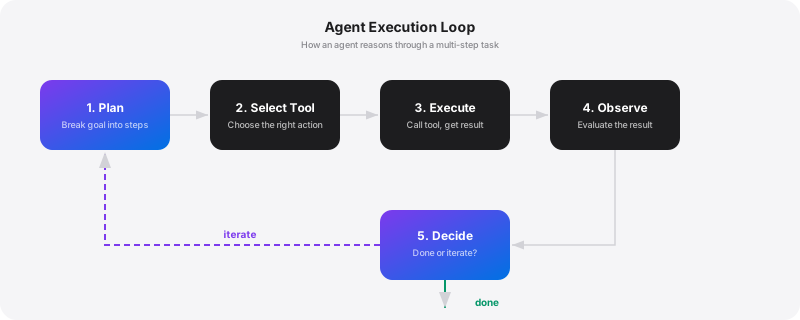
Agentic AI breaks this pattern fundamentally. An agent receives a high-level goal and then autonomously determines the steps needed to achieve it. It reasons about sub-tasks, executes them in sequence or parallel, observes the results, adjusts its plan, uses external tools, and iterates until the goal is met or it determines the goal cannot be achieved.
The distinction matters because the engineering challenge is entirely different. Building a chatbot that answers questions well is primarily a prompt engineering problem. Building an agent that reliably completes multi-step tasks in production is a systems engineering problem, and a substantially harder one.
The Architecture of a Production Agent System
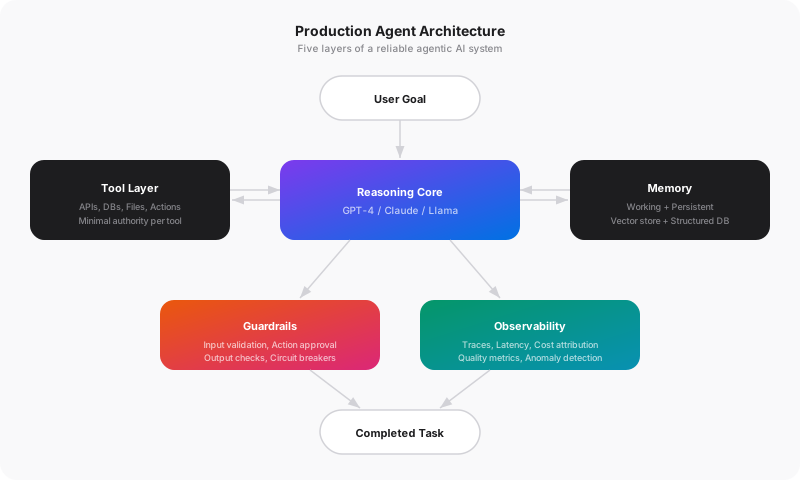
After building several agentic systems, we have converged on an architecture with five core layers. Each layer addresses a specific concern, and getting any one of them wrong undermines the entire system.
The Reasoning Core
At the centre sits a large language model, GPT-4, Claude, Llama, or another capable model, acting as the reasoning engine. The model’s job is to interpret the goal, break it into steps, decide which tools to use, evaluate intermediate results, and determine when the task is complete.
The choice of model matters more than most teams realise. We typically evaluate models along four dimensions for agentic workloads: instruction following accuracy, tool-calling reliability, context window utilisation, and cost per task completion. A model that performs well on benchmarks may still fail at reliable tool calling, which is the single most important capability for agentic systems.
In practice, we often use different models for different parts of the agent. A larger, more capable model handles the planning and decision-making, while a smaller, faster model handles routine sub-tasks like data extraction or classification. This router pattern keeps costs manageable without sacrificing quality where it matters.
The Tool Layer
Tools are what transform an LLM from a text generator into an agent that can act on the world. A tool is any function the agent can invoke: querying a database, calling an API, reading a file, sending an email, creating a ticket, or executing code.
The design of the tool interface is critical. Each tool needs a clear, unambiguous description that the model can interpret. Parameter schemas must be precise. Error responses must be informative enough for the model to recover. We have found that poorly designed tool descriptions are the single most common cause of agent failures in production, the model misinterprets what a tool does, passes wrong parameters, or fails to handle errors gracefully.
We follow a principle we call “minimal authority” for tool design. Each tool should do exactly one thing, with the narrowest possible scope of permissions. An agent that needs to look up customer data should have a read-only tool for that specific query, not broad database access. This constraint makes the system safer and also makes the model’s job easier, fewer tools with clearer purposes lead to more reliable tool selection.
Memory and State
Agents need memory to function across multi-step tasks. We implement two types:
Working memory is the context maintained during a single task execution. This includes the original goal, the plan, results from completed steps, and any relevant state. The practical challenge here is context window management. Long-running tasks can generate substantial intermediate output, and naive implementations that dump everything into the context window quickly hit limits and degrade performance. We use summarisation strategies and selective context injection to keep working memory focused and efficient.
Persistent memory spans across task executions. This might include learned user preferences, cached tool results, or accumulated knowledge about the environment. Implementing persistent memory well requires careful decisions about what to store, when to retrieve it, and how to keep it current. We typically use a combination of vector storage for semantic retrieval and structured databases for factual state.
Guardrails and Safety
This is where most prototype-to-production transitions fail. A demo agent that works 90% of the time is impressive. A production agent that fails 10% of the time is a liability.
Our guardrail framework operates at multiple levels:
Input validation ensures the agent only accepts tasks within its defined scope. If someone asks a customer support agent to modify billing records, the system should reject the request before the agent even starts planning.
Action approval gates high-impact actions behind human review. We implement a configurable risk scoring system: low-risk actions (reading data, generating reports) execute automatically, while high-risk actions (sending emails, modifying records, making purchases) require explicit approval. The threshold is configurable per deployment.
Output validation checks agent outputs against defined constraints before they reach the user or downstream systems. This includes content safety filters, format validation, and business rule checks.
Circuit breakers detect when an agent is stuck in loops, consuming excessive resources, or generating nonsensical outputs. The system automatically halts execution and escalates to human oversight.
Observability
You cannot debug what you cannot see. Every production agent system needs solid observability, and this is an area where the tooling is still maturing.
We instrument every agent with:
- Trace logging that captures the full chain of reasoning, tool calls, and decisions. Each trace links the original goal to every intermediate step and the final outcome.
- Latency tracking at each step, broken down by model inference time, tool execution time, and orchestration overhead.
- Cost attribution that tracks token usage and tool costs per task, per agent, and per customer.
- Quality metrics including task completion rate, human override frequency, and user satisfaction scores.
- Anomaly detection that flags unusual patterns, agents taking significantly more steps than expected, tools returning unexpected errors, or costs spiking beyond normal ranges.
We use a combination of OpenTelemetry for distributed tracing and custom dashboards for agent-specific metrics. The observability layer typically represents 15-20% of the total engineering effort for an agent system, and it is worth every hour invested.
Where Agents Deliver Real Value Today
Not every problem needs an agent. For simple tasks, traditional automation or basic LLM calls are faster, cheaper, and more predictable. Agents earn their complexity when the task involves multiple dimensions of difficulty simultaneously.
Document Processing Pipelines
A document lands in your system, an invoice, a contract, a compliance filing. The agent classifies the document type, extracts relevant fields using different strategies for different document types, validates the extracted data against business rules, routes exceptions for human review, and updates downstream systems. Each step depends on the previous one, and edge cases require judgement rather than rigid rules.
We built a system like this for a consulting client that processes several hundred documents daily. The agent handles roughly 85% of documents end-to-end without human intervention. The remaining 15% are flagged for review, but even those arrive with the agent’s preliminary extraction already completed, cutting human processing time by roughly 60%.
Customer Support Resolution
Not triage, actual resolution. An agent that can access order data, knowledge bases, shipping systems, and refund tools can resolve a meaningful percentage of customer issues without human involvement. The key is building tight integration with backend systems and implementing clear escalation paths for situations the agent cannot handle.
Research and Analysis Workflows
An analyst needs to compile a competitive analysis report. The agent searches multiple data sources, extracts relevant information, cross-references findings, identifies patterns, and produces a structured report with citations. Tasks that would take a human analyst hours can be completed in minutes, with the human’s role shifting from data gathering to insight validation.
The Honest Assessment
Agentic AI is real, the results are measurable, and the organisations that adopt it thoughtfully will build a significant competitive advantage. But the technology is not magic, and the engineering challenges are substantial.
Model reliability is improving but not yet where it needs to be for fully autonomous operation in high-stakes environments. The cost profile is still significant for complex multi-step tasks, each planning step, tool call, and re-evaluation consumes tokens. The tooling ecosystem for building, testing, and monitoring agents is immature compared to traditional software development.
Our recommendation: start with a specific, well-defined problem rather than a broad “let us add AI agents everywhere” initiative. Choose a use case where the value is clear, the risk of errors is manageable, and you can measure success objectively. Build it properly with guardrails and observability from day one. Learn from the deployment, then expand.
The organisations that will benefit most from agentic AI are not the ones that move fastest. They are the ones that move most deliberately, building production systems with engineering discipline rather than rushing demos into production and hoping for the best.